HOW TO KNOW IF I’M UNDER INVESTIGATION IN ITALY – 335 PETITION

335 ONLINE PETITION – HOW TO KNOW IF I’M UNDER INVESTIGATION IN ITALY

Not everyone is aware that the Italian legal system allows checking whether one’s name has been entered in the register of suspects in a criminal proceeding or the status of a previously filed complaint, i.e., to which prosecutor it has been assigned and under what registration number.

On the other hand, if you want to know your criminal record, you need to request a criminal record certificate, which you can request HERE.

Specifically, the article 335 of the italian Code of Criminal Procedure stipulates that the Public Prosecutor shall enter in the appropriate register any report of a crime of which he has become aware.
In most italian public Prosecutor’s Offices, the application can also be submitted online; a list is provided below.
To obtain the certificate ex 335 c.p.p., fill out the application form you can find HERE.

WHO CAN ACCESS THE REGISTRY AND WHAT IS OBTAINED FOLLOWING SUBMISSION OF THE PETITION

The petition ex art. 335 c.p.p. can be proposed by anyone interested personally or through a lawyer.
Once the request has been submitted to the competent public prosecutor’s office, in the case of a request submitted by anyone who believes he or she is under investigation, a notice will follow stating:
– that there are no entries susceptible to disclosure (negative certification);
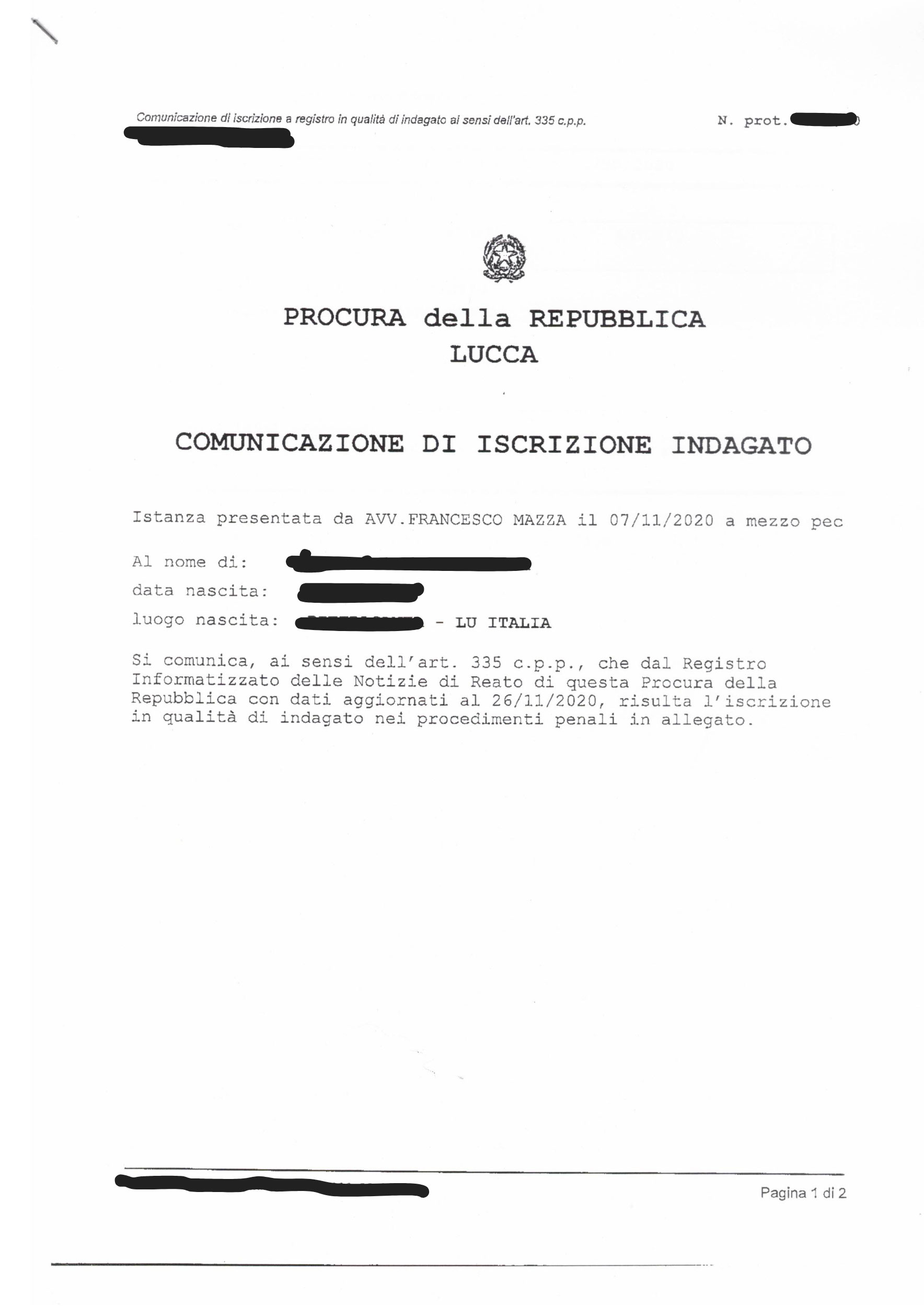
– the registration of the individual in the register of suspects, the identifying data of the suspect, the case roll number, the prosecutor proceeding and the crime for which one is under investigation (positive certification);
In the case of an application filed by the offended person as a result of the previously filed complaint, a notice will follow stating:
– that there are no entries susceptible to communication (negative certification);
– the identifying data of the offended person, the role number of the proceeding, the prosecutor proceeding and the offense charged against the suspect consequent to the complaint filed (positive certification).

WHAT IS THE PURPOSE OF KNOWING IF YOU ARE LISTED ON THE REGISTER OF SUSPECTS?

Becoming aware of a possible entry in the register of suspects can be a great advantage, as it allows you to anticipate the development of an appropriate defense strategy with your lawyer. The suspect can immediately file defense briefs and documents with the secretary of the prosecuting prosecutor.
The offended person, having become aware of the references to the criminal proceedings established as a result of the complaint filed, may also submit written pleadings, additions and documents; or request the taking of summary information.

WHAT IS THE REGISTER OF SUSPECTS AND WHAT IS INVOLVED IN ENTERING A NAME

As mentioned, Article 335 of the Code of Criminal Procedure stipulates that the Public Prosecutor, i.e., the magistrate prosecuting the case, shall enter in the appropriate register any report of a crime of which he has become aware.
Such inclusion in the register of suspects does not necessarily imply that there will be a criminal trial, but allows the prosecutor to carry out acts of investigation even without informing the suspect.
Being placed on the register of suspects means being subject to investigation by the prosecutor’s office as a result of a criminal report, which may result from a complaint, a denunciation, or even simply a report.

NEGATIVE OUTCOME

In the event of a negative result, the formula that is affixed to the certificate is the following “NON RISULTANO ISCRIZIONE SUSCETTIBILI DI COMUNICAZIONI” and normally means that the person is not a suspect.

In fact, it should be clarified that in specific cases the suspect’s right to be informed of the entry of his name in the register of suspects may be subject to certain limitations:

– for the serious crimes provided for in Art. 407 c. 2 lett. a c.p.p.
– by decision of the prosecutor, as provided for in Article 335 c.3 of the Code of Criminal Procedure, if the investigation is particularly complex for a period not exceeding three months.
In such cases, the 335 cpp certificate will have a negative outcome, so it is therefore advisable to repeat the request after three months, so as to obviate the hypothesis that it was the PM who decided for the secrecy of the investigation.

THE STAGES OF CRIMINAL PROCEEDINGS

To verify the status of ongoing criminal proceedings, it’s essential to understand the stages involved. The registration of suspects takes place during the preliminary investigation, which marks the initial phase of the criminal process.

Criminal proceedings consist of the following stages:

– Preliminary investigation at the end of which the PM will ask the Judge (GIP) to dismiss or remand the case for trial based on the findings of the investigation;

– Preliminary hearing in which the Judge (GUP) decides on remand or dismissal;

– Trial – phase following any indictment and in which evidence is formed following the principle of cross-examination;

– Judgment – decision of the Judge.


In summary, to check whether you are under investigation in a criminal proceeding, simply fill out the form provided BELOW.

Within a variable timeframe—usually no longer than 15 days (maximum 30)— your request will be processed (we process requests within 48 hours, but final timing depends on the efficiency of the Prosecutor’s Offices).

ONLINE PAYMENT

€ 50

Standard Delivery

SAMPLE OF CERTIFICATE

LIST OF PUBLIC PROSECUTORS’ OFFICES WHERE THE CERTIFICATE CAN BE REQUESTED ONLINE


Procura della Repubblica Indirizzo Località
ANCONA Via Giacomo Matteotti, 48, 60121 Ancona
AREZZO Piazza Giovanni Falcone e Paolo Borsellino, 1, 52100 Arezzo
ASCOLI PICENO Piazza Serafino Orlini, 1 , 63100 Ascoli Piceno
AVELLINO Piazza D’Armi, 2, 83100 Avellino
AVEZZANO Camillo Corradini, 144, 67051 Avezzano
BARI Viale Dioguardi, 5, 70124 Bari
BENEVENTO Via De Caro, 7, 82100 Benevento
BERGAMO Piazza Alighieri Dante, 2, 24121 Bergamo
BRINDISI via Angelo Lanzellotti, 3, 72100 Brindisi
BRESCIA via Gambara Lattanzio, 40, 25121 Brescia
BOLOGNA via Garibaldi, 6, 40124 Bologna
BOLZANO Piazza Tribunale, 1, 39100 Bolzano
CAMPOBASSO Piazza Vittorio Emanuele II, 26, 86100 Campobasso
CAGLIARI Piazza della Repubblica, 18, 09125 Cagliari
CASSINO P.za  A. Labriola, 1, 03043 Cassino
CHIETI Via Silvio e Beltrando Spaventa, 4, 66100 Chieti
CIVITAVECCHIA Via Terme di Traiano, 56, 00053 Civitavecchia
CREMONA Via Jacini, 6/A, 26100 Cremona
CUNEO Piazza Galimberti, 7, 12100 Cuneo
ENNA Viale Armando Diaz, 10 – 94100 Enna
FERRARA via Borgo dei Leoni, 60, 44121 Ferrara
FIRENZE Viale Alessandro Guidoni, 61, 50127 Firenze
FOGGIA Viale I Maggio, 30, 71122 Foggia
GENOVA Piazza Portoria, 1, 16121 Genova
LANCIANO Via Fiume, 14, 66034 Lanciano
LARINO P.za del Popolo, 1, 86035 Larino
LA SPEZIA Viale Italia, 142, 19124 La Spezia
LODI Viale Milano, 2, 26900 Lodi
LUCCA via Galli Tassi, 61, 55100 Lucca
MACERATA Via Pesaro, 6, 62100 Macerata
MARSALA Via del Fante, 50/A, 91025 Marsala
MATERA Viale Aldo Moro, 26, 75100 Matera
MILANO Via Freguglia Carlo, 1, 20122 Milano
MESSINA Via Tommaso Cannizzaro – Piazza S. Pugliatti 98100 Messina
MODENA Corso Canalgrande, 77, 41121 Modena
MONZA Via Laura Solera, 3, 20900 Monza
NAPOLI Via Costantino Grimaldi, E/5, 80143 Napoli
NAPOLI NORD – AVERSA Piazza Trieste e Trento, 27, 81031 Aversa
NOCERA INFERIORE Via Falcone, 12-14, 84014 Nocera Inferiore
NOLA Palazzo Orsini – Piazza G. Bruno 80035 Nola
NOVARA Baluardo La Marmora, 17, 28100 Novara
PADOVA Via Niccolò Tommaseo, 55, 35131 Padova
PARMA Piazzale Corte d’Appello, 1, 43121 Parma
PALERMO P.za Vittorio Emanuele Orlando, 1, 90138 Palermo
PAOLA Via Giovanni Falcone e Paolo Borsellino, 9, 87027 Paola
PAVIA Piazza del Tribunale, 1, 27100 Pavia
PERUGIA Piazza Matteotti, 1, 06126 Perugia
PISA Piazza della Repubblica, 5, 56127 Pisa
PORDENONE Piazza Giustiniano, 7, 33170 Podernone
POTENZA Via Nazario Sauro, 71, 85100 Potenza
PRATO Piazzale Falcone e Borsellino, 8, 59100 Prato
RAVENNA Viale G. Falcone, 67, 48124 Ravenna
REGGIO EMILIA Via Avvenire Paterlini n. 1, 42124 Reggio nell’Emilia
RIMINI Viale Carlo Alberto dalla Chiesa, 11, 47923 Rimini
ROMA Via Golametto, 12, 00196 Roma
ROVERETO Corso Rosmini Antonio, 65 – 38068 Rovereto
SALA CONSILINA Contrada Tressanti, Sala Consilina, 84036 Sala Consilina
SALERNO Torre F “Nicola Giacumbi” in viale dell’Unità d’Italia, 84122 Salerno
SANTA MARIA CAPUA VETERE Piazza della Resistenza, 81055 Santa Maria capua Vetere
SASSARI Via Roma, 49, 07100 Sassari
SAVONA Piazza Barile, 1, 17100 Savona
SIRACUSA V. le Santa Panagia, 109, 96100 Siracusa
TERMINI IMERESE Piazza F. Ugo Di Blasi, 1 – 90018 Termini Imerese
TREVISO Viale Giuseppe Verdi, 18, 31100 Treviso
TORINO C.so Vittorio Emanuele II, 130, 10138 Torino
TRANI via Accademia dei Pellegrini, 16, 76125 Trani
TRAPANI Via XXX Gennaio, 17, 91100 Trapani
TRIESTE Foro Ulpiano, 1, 34133 Trieste
TRENTO Largo Luigi Pigarelli, 1, 38122 Trento
VARESE Piazza Cacciatori delle Alpi, 4, 21100 Varese
VENEZIA Santa Croce, 430/Edificio 3, 30135 Venezia
VERBANIA Corso Europa 3, 28922 Verbania
VERCELLI Piazza Amedeo IX, 6, 13100 Vercelli
VERONA Via dello Zappatore, 1, 37122 Verona
VICENZA Via Ettore Gallo,24, 36100 Vicenza
UDINE Via Lovaria, 8, 33100 Udine

FAQ ON THE APPLICATION UNDER ARTICLE 335 OF THE ITALIAN CODE OF CRIMINAL PROCEDURE


What is an application under Article 335 of the Italian Code of Criminal Procedure and what is it for?

An application pursuant to Article 335 of the Italian Code of Criminal Procedure is a formal request addressed to the Public Prosecutor’s Office to find out whether one’s name has been entered in the register of crime reports or to learn the outcome of a criminal complaint that has been filed.
In other words, it is used to determine whether there is an ongoing criminal proceeding against oneself (i.e. whether one is under investigation) or relating to an offence of which one is the victim (injured party).
Through this application, it is possible to obtain from the Prosecutor’s Office Records Office a “certificate pursuant to Article 335 of the Code of Criminal Procedure,” which will indicate whether there are any ongoing investigations and provide the essential details of the criminal proceeding (case number, alleged offence, assigned public prosecutor, etc.).

Who can request a certificate pursuant to Article 335 of the Code of Criminal Procedure?

The following persons may submit an Article 335 application:

The injured party (victim/complainant) – for example, someone who has filed a criminal complaint and wishes to know its progress;

– The person under investigation (suspect) – someone who suspects they may be under investigation and wants to verify whether their name has been entered in the register of suspects;

– Defense counsel – a lawyer appointed by the injured party or the suspect may submit the application on the client’s behalf.

Where is the Article 335 application filed and how is the request made?

The application must be filed with the territorially competent Public Prosecutor’s Office, namely the office of the place where the alleged offence is believed to have been committed.
It can be submitted through the Ministry of Justice’s online services portal or via a lawyer.

Is there a cost for filing an Article 335 application?

No. An application pursuant to Article 335 of the Code of Criminal Procedure does not involve any administrative costs: it is exempt from stamp duty and administrative fees. This means that filing the request with the Public Prosecutor’s Office is free of charge.
However, if a lawyer is engaged to submit the application, the agreed professional fee for the service must be paid (which may vary depending on the lawyer and the urgency).

How long does it take to receive a response to an Article 335 application?

There is no mandatory deadline set by law within which the Public Prosecutor’s Office must respond to an Article 335 request. Generally, after filing the application, several weeks may pass before the certificate is issued and the outcome communicated.
Timeframes may vary depending on the specific Prosecutor’s Office and its workload: in some cases, the result is provided within 2–4 weeks, while in others it may take longer.

How long can preliminary investigations last?

Preliminary investigations (i.e. the investigative phase carried out by the Public Prosecutor and the judicial police) cannot last indefinitely.
The law provides for an ordinary maximum duration of six months, which may be extended up to 18 months and, for offences listed under Article 407 of the Code of Criminal Procedure, up to 24 months.
Once these time limits expire, the Public Prosecutor must make a decision: either to initiate criminal proceedings (by requesting that the suspect be committed for trial) or to request that the case be dismissed.
In short, after a maximum of one and a half years (or two years in the most serious cases) from registration, the investigations must be concluded and the Public Prosecutor must submit a request to the investigating judge (GIP).

Can a 335 petition have a negative outcome even if an investigation is ongoing?

Yes, it can happen. A negative outcome means that no proceedings are shown in the Article 335 certificate as being registered against the person (the certificate is “blank”). However, this does not guarantee with absolute certainty that no investigations are underway. The main reasons may be two:

  • Delay in registration: it may be that the report of a crime (complaint/criminal report) has been transmitted to the authorities but has not yet been formally entered in the register at the time the request is made. There is often a natural delay in registrations, so if the application is filed very soon after the reported facts, there is a risk of obtaining a “provisional” negative result. In this case, it is advisable to submit the request again after a few weeks, allowing the Prosecutor’s Office time to update its records.

  • Investigative secrecy: in certain situations, especially for particularly serious offences (e.g. mafia association, terrorism, homicide), the Public Prosecutor may order, by a reasoned decision, that the registration in the register of crime reports not be disclosed for an initial period not exceeding three months, in order to protect investigative needs. During this period of secrecy, even if an investigation is actually ongoing, an application pursuant to Article 335 of the Code of Criminal Procedure may have a negative outcome or provide no information to the applicant.

What does a negative Article 335 result mean?

In short, a certificate pursuant to Article 335 of the Code of Criminal Procedure with a negative outcome means that, at the time, there are no registrations against the person in the register of crime reports. However, this does not exclude the possibility that a registration may occur later; therefore, it may be appropriate to submit the application again after a certain period of time.

If the Public Prosecutor intends to request dismissal of the case, the complainant is informed, provided that they have previously stated their wish to receive such notice, in order to be able to lodge an objection to the dismissal request.

From the suspect’s perspective, an application pursuant to Article 335 of the Code of Criminal Procedure submitted after the proceedings have already been dismissed—upon request by the Public Prosecutor and order of the investigating judge (GIP)—can only result in the wording: “no registrable entries subject to disclosure are found.”

Can I submit a 335 petiton  if I am abroad?

Yes. It is not necessary to be physically in Italy to request a certificate pursuant to Article 335 of the Code of Criminal Procedure. If you are abroad and wish to know the status of proceedings in Italy (for example, because you filed a complaint while you were in Italy, or because you fear you may have been reported), you can still submit the application.
In practice, there are two options: appoint a trusted lawyer in Italy to file the application on your behalf, or submit it yourself remotely. In any case, it is advisable to be guided by a lawyer familiar with the practices of the relevant Prosecutor’s Office—especially if you do not speak Italian—to avoid the request being rejected due to formal defects.

If I am abroad, how are notifications of criminal procedure documents carried out?

Even if you are abroad, notifications of documents in criminal proceedings can still be carried out, but the methods vary depending on your procedural status (injured party or suspect/defendant).

If you filed a complaint in Italy as the injured party, you are usually asked to indicate an address for service, which may also be elected at the office of a trusted lawyer. If no address for service in Italy is elected, communications may be sent to the foreign address provided, often by international registered mail; in some cases, the authority may invite you to elect an address in Italy to facilitate subsequent notifications.

Conversely, for suspects or defendants, the law places particular importance on the declaration or election of domicile (Articles 161 et seq. of the Code of Criminal Procedure). If the suspect or defendant has not declared or elected a suitable domicile, the authority proceeds with notifications in accordance with the rules set out in the Code of Criminal Procedure. Only if the recipient is deemed untraceable, following the prescribed searches, does the law allow certain documents to be served by deposit with the court registry or the Prosecutor’s Office, with formal validity of service.

It may happen—especially when a person resides permanently abroad—that notifications do not actually reach the recipient due to postal difficulties or the absence of an elected domicile in Italy. For this reason as well, it may be useful to submit an application pursuant to Article 335 of the Code of Criminal Procedure.

Through the Article 335 certificate, it is possible to verify whether a criminal proceeding has been registered and, if so, to take timely action—for example by appointing a defence lawyer in Italy and electing domicile—in order to obtain information and review documents that may not have been physically received.

What does “RG” mean in criminal proceedings?

“RG” is the abbreviation for Registro Generale (General Register). Each criminal proceeding has its own identifying number, known as the general register number of the offence. Essentially, it is the protocol number assigned to the case file by the judicial office.
On the certificate pursuant to Article 335 of the Code of Criminal Procedure, if a proceeding is recorded, the relevant RG number is indicated (along with other information). For example, one might read “Proc. no. RG 1234/2025”: that number is the unique code by which the Prosecutor’s Office identifies the specific case.

What information does a positive Article 335 certificate contain?

If the Article 335 application has a positive outcome, it means that at least one criminal proceeding has been registered. In that case, the certificate issued by the Prosecutor’s Office will generally contain:

– The number of the criminal proceeding – i.e. the RG (general register) number of the case file;

– The competent authority (namely, the Prosecutor’s Office with which the application was filed) and the Public Prosecutor in charge of the investigation;

– The personal details of the injured party (if the request is made by the victim) or of the suspect (if made by the suspect) – in order to link the registration to the person concerned;

– The legal classification of the alleged offence – i.e. the provision of law considered to have been violated and a brief description of the offence under investigation (e.g. “aggravated theft, Article 624 of the Criminal Code”).

In essence, a positive Article 335 certificate will tell you what is being investigated, by which Prosecutor’s Office, under which case number, and who the responsible Public Prosecutor is. It does not include detailed information about the investigation (such as evidence or the names of other suspects); for that, it will be necessary to access the case file through a defence lawyer.

If the 335 petition shows that there is a criminal proceeding, what should I do?

If the certificate pursuant to Article 335 of the Code of Criminal Procedure has a positive outcome, it means that the complaint has resulted in an ongoing criminal proceeding or that you are formally registered as a suspect. In this situation, it is strongly advisable to appoint a trusted lawyer, if you have not already done so.

Once the appointment is filed with the Prosecutor’s Office, the defence counsel will be officially included among the recipients of communications relating to the proceedings and will be able to access the case file when permitted by law, particularly from the conclusion of the preliminary investigations onward. In this way, the lawyer:

– will be promptly informed of developments in the proceedings (e.g. a request for dismissal, notice of conclusion of investigations, committal for trial);

– will be able to protect your rights by submitting briefs, applications, and defence documents during the investigation phase, within the limits allowed;

– if you are the injured party, will be able to monitor the progress of the investigations and, where appropriate, prompt the Prosecutor’s Office or oppose a request for dismissal;

– if you are a suspect, will be able to establish a defence strategy from the outset, including by conducting defence investigations to gather evidence in your favour.

In summary, a positive outcome of an application pursuant to Article 335 of the Code of Criminal Procedure makes the immediate assistance of a defence lawyer advisable, in order to participate knowingly in the proceedings and avoid the risk of missing communications or opportunities to protect your rights.

ONLINE PAYMENT

€ 50

Standard Delivery

error: Content is protected !!